Tuesday, September 06, 2011
Canola harvested in very hot weather has to go on aeration to cool it off. Even if dry, hot canola can start to heat and spoil within weeks.
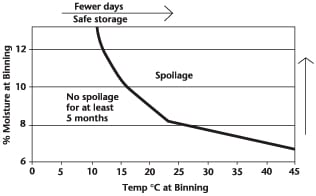
Canola at 10% moisture is at risk of spoilage when put in the bin at 20 C. “At temperatures above 30 C, which was the harvest temperature for a lot of canola binned over the past couple weeks, the spoilage risk is that much greater,” says Kristen Phillips, agronomy specialist with the Canola Council of Canada.
Even canola binned at moisture contents below 8% may still be at risk at these high temperatures, Phillips adds.
Green seeds and dockage, including canola plant material, weed material and insect parts, create additional start points for heating and can make the situation worse.
All canola should be conditioned immediately after harvest. “Conditioning” involves the movement of air through seed to ensure safe storage over a period of time. The basic recommendation is to put canola into aeration bins immediately after harvest and turn the fans on until canola has cooled to 15 C. If aeration bin space is not available, keep moving the canola from bin to bin until it cools.
“The act of augering canola from one bin to another will circulate air through the seed, cool it off and remove any developing hot spots,” Phillips says. “In fact, this practice is also useful for canola that has been on aeration. Moving canola after a couple weeks on aeration adds another level of security to make sure the highly valuable crop is safe.”
Monitor canola throughout the aeration process to make sure the temperature is coming down. Bin temperature cables simplify the monitoring process. If temperatures stop falling or worse, start rising again, this is a bad sign that heating may have begun. Empty the whole bin to break up hot spots and cool off the mass, then put the canola back on aeration.
If growers are concerned about the safety of canola binned hot or tough or with high green counts, they may want to consider early delivery to the elevator or crush facility. Check your options.
“The first 4 to 6 weeks after putting the canola in the bin is the most critical time,” Phillips says. “Don’t forget about your stored canola while tending to your other harvest duties. It could be a very costly oversight.”
– 30 –
Media can contact a Canola Council of Canada agronomy specialist in your region:
Kristen Phillips
Manitoba, phillipsk@canolacouncil.org 204-761-2143
Jim Bessel
Central Saskatchewan, besselj@canolacouncil.org 306-373-6771
Shawn Senko
Eastern Saskatchewan, senkos@canolacouncil.org 306-270-9307
Clint Jurke
Western Saskatchewan, jurkec@canolacouncil.org 306-821-2935
Troy Prosofsky
Southern Alberta, prosofskyt@canolacouncil.org 403-332-1412
Dan Orchard
Central Alberta, orchardd@canolacouncil.org 780-777-9923
Doug Moisey
North Central Alberta, moiseyd@canolacouncil.org 780-645-9205
Greg Sekulic
Peace Region, sekulicg@canolacouncil.org 780-832-2382
This media release is supported regionally by:
Alberta Canola Producers Commission; SaskCanola; Manitoba Canola Growers Association; Canola Council of Canada; Peace River Agriculture Development Fund; B.C. Ministry of Agriculture & Lands.


