What is canola oil?
Canola oil is one of the healthiest cooking oils available, with zero trans fat and the lowest amount of saturated fat of all common cooking oils. And because canola oil is so versatile and affordable, it’s ideal for making a wide range of healthy foods, both at home and on a commercial scale. Canola oil comes from the seeds of the canola plant, one of the most widely grown crops in Canada. After harvesting, canola seeds are crushed to release the canola oil.
Consulter cette information en français / View this information in French.
Learn more in the fact sheets:
Canola oil facts

Half the saturated fat of soybean or olive oil

From the same plant family as cabbage, broccoli, Brussels sprouts and mustard

Rich source of vitamins E and K and plant sterols
Learn more about:
Canola oil facts and fiction
What is canola?
Canola is a crop grown in Canada, Europe, Australia and some parts of the United States. The plants produce small yellow flowers that develop into pods, similar to pea pods. Inside each pod are tiny black seeds that are packed with trans-fat-free oil. After harvesting, the seeds are crushed to release the canola oil from the seed’s protein-rich solids. The oil and solids then undergo further processing – the oil for cooking oil and food products, and the solids as a high-value ingredient for animal feeds. Today canola is also used as a feedstock for renewable fuels.
Is canola oil healthy?
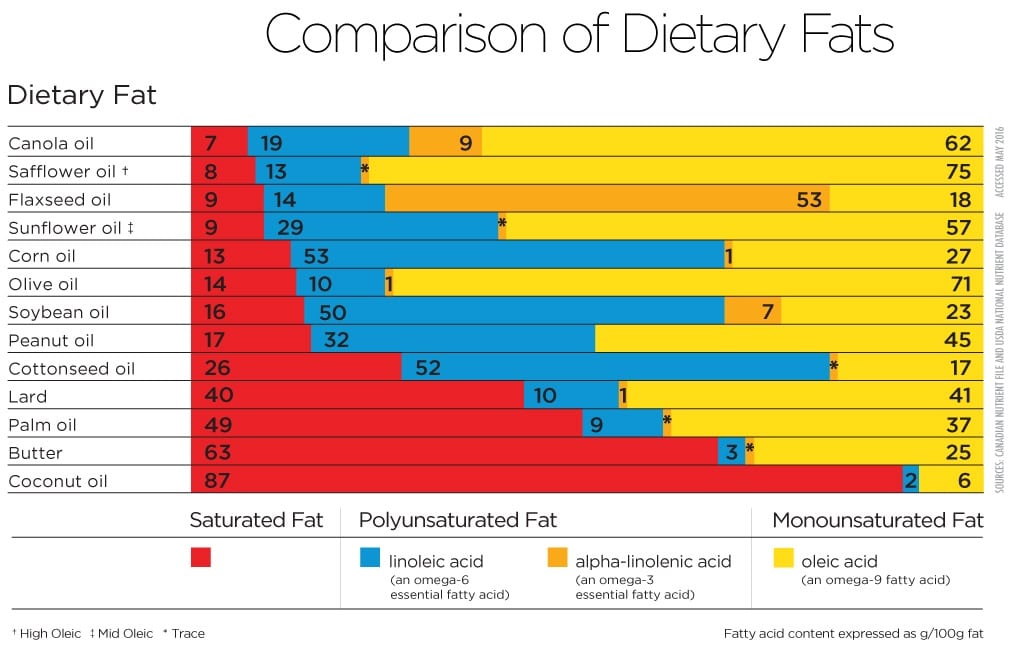
Canola oil is high in unsaturated fats and has the lowest amount of saturated fat among the common cooking oils. It contains high amounts of oleic acid (a monounsaturated fat) and alpha-linolenic acid (the plant-based omega-3 essential fatty acid).
Many clinical trials have shown that canola oil has health benefits when used instead of other fat sources. Canola oil is eligible to carry a qualified health claim from the U.S. Food and Drug Administration (FDA) for its ability to reduce the risk of coronary heart disease when used in place of saturated fat in the diet.
What is canola oil made of?
Canola oil comes from the seeds of the canola plant, one of the most widely grown crops in Canada. Canola plants produce beautiful small yellow flowers which develop into pods, resembling pea pods. Each pod contains tiny black seeds, made up of about 45% oil. Once harvested, canola seeds are crushed to release the oil contained within the seed. The oil is then further refined and bottled as canola oil.
Rapeseed vs. canola: Is canola the same as rapeseed?
Canola is sometimes mistaken for rapeseed because canola was originally bred from rapeseed and the plants are similar in appearance. However, canola has much lower levels of erucic acid and glucosinolates – the characteristics that make rapeseed undesirable. To meet the official definition of canola, the plant must produce oil containing less than 2% erucic acid. The meal must contain less than 30 micromoles of glucosinolates per gram of air‑dried oil-free meal.
In scientific studies, canola oil has been shown to have a positive effect on several chronic health conditions. It is Generally Recognized as Safe (GRAS) for human consumption, including use in infant formula. Canola oil is eligible to carry a qualified health claim from the U.S. Food and Drug Administration (FDA) for its ability to reduce the risk of coronary heart disease when used in place of saturated fat in the diet.
Was canola developed using genetic engineering?
Canola was developed using traditional plant breeding during the 1960s and 1970s, long before biotechnology was available. Using selective breeding techniques, plant developers were able to lower the two unwanted components of rapeseed and develop a new plant now called canola. Later, traditional breeding was also used to develop the high oleic canola oil used by the food industry as an alternative to artificial trans fat.
Today, many different varieties of canola are available, including genetically modified (GM) and non-GM canola. Plant breeders are constantly making improvements to help farmers deal with challenges such as drought, pests and crop diseases. New plant traits such as herbicide tolerance have helped canola farmers switch to no-tillage practices and use smaller amounts of herbicides to control weeds, keeping soil moist and fertile.
Regardless of whether it comes from GM or non-GM plants, the oil from canola is exactly the same. In herbicide-tolerant canola, the modification has been made to only one canola gene. That gene is a protein, and all proteins are removed from canola oil during processing. That means canola oil made from GM seed is conventional canola oil.
How is canola oil processed?
Canola oil is processed similarly to other seed oils. After thorough cleaning, canola seed is crushed to extract the oil. The seed may be “cold-pressed,” but in most cases, the seed is heated and flaked to allow more oil to be released. Oil is not water-soluble, so an approved solvent called hexane can be used to remove more of the oil from the seed solids. The hexane is used under carefully controlled conditions, and is recycled and reused. It does not stay in the oil or the solids.
Following extraction, the oil can be further refined to produce a shelf-stable, clear and neutral-tasting oil. Color pigments can be removed by a filter containing natural clay (a process sometimes describing as “bleaching,” although no bleach is involved). Great care is taken to ensure the finished product is of high quality. Canola oil processed in this way can be stored at room temperature for about one year.
After the oil has been extracted, the solid parts of canola seed are processed into canola meal. This protein-packed product is used in animal feed.
Have human studies been conducted on the consumption of canola oil?
Over several decades, many different investigators have conducted peer-reviewed clinical trials involving thousands of human volunteers. These studies examined the role of canola oil in lowering blood cholesterol levels and reducing risk of coronary heart disease, cancer, diabetes and high blood pressure. Links to these studies are in the Canola Oil Research Directory
Canola is Generally Recognized as Safe (GRAS) for human consumption, including use in infant formula.
What are some other uses for canola oil?
Like most crops, canola has many other uses beyond food. Canola oil be used to make environmentally friendly inks, lubricants, soaps, paints, plastics and cosmetics. Oils from olives, corn, soybeans and flax are often used for these same industrial purposes.
One of the newest uses for canola is as a feedstock for making renewable fuels. Canola is increasingly used to produce low-carbon biodiesel, which has the potential to greatly reduce greenhouse gases.
How long can canola oil be stored?
Canola oil’s shelf life at room temperature is about one year. The shelf life of most plant-based cooking oils is similar.
What is canola oil’s smoke point?
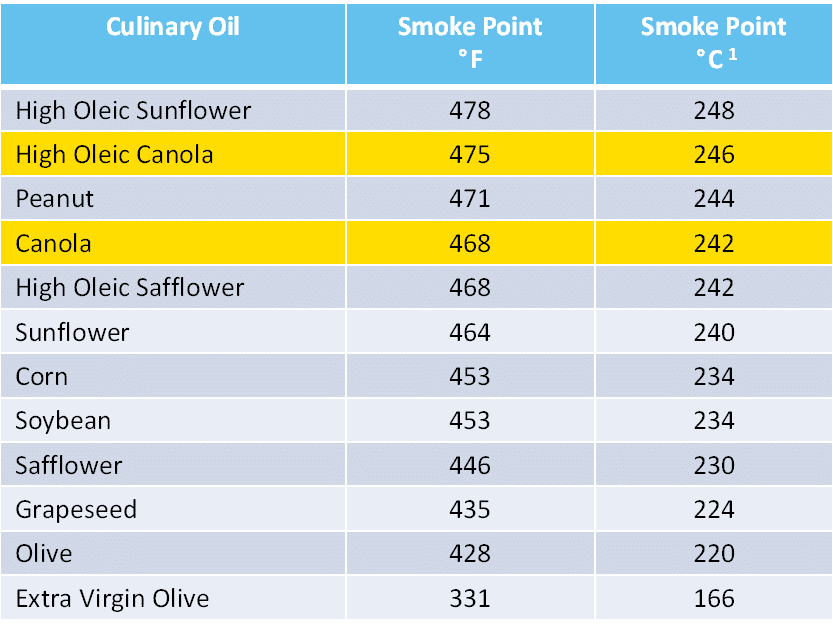
Canola oil has a smoke point of 468˚F. This means it can be used for sautéing and deep frying without fear of the oil smoking or developing significant trans fatty acids when heated at a high temperature. To compare the smoke points of some common cooking oils, refer to the chart below.
Canola oil benefits
More healthy fats than any other common cooking oil
Canola oil is rich in good fats and can help reduce the risk of heart disease when used instead of saturated fats by reducing LDL cholesterol in the blood.
Canola oil has:
- Just 7% saturated fat – the least of the common culinary oils
- No trans fat
- The most plant-based omega-3 fat of any common cooking oil
- High levels of monounsaturated omega-9 fat (oleic acid)
- Source of omega-6 fat
Research-backed health benefits
A growing body of scientific research suggests canola oil can have positive effects on several chronic health problems, including heart disease, diabetes and metabolic syndrome.*
Among the research findings:
- “Bad” (LDL) cholesterol in the blood dropped an average of 16.2% when study volunteers consumed canola oil instead of a high saturated fat diet for 2.5-13 weeks.
- A low glycemic-load diet with canola oil helped improve both blood cholesterol and blood glucose control in Type 2 diabetes patients.
- Abdominal fat mass, as well as blood pressure, significantly decreased in subjects at risk of metabolic syndrome who consumed canola and high oleic canola oil.
Many health organizations have recognized canola oil as a heart-smart oil. The U.S. Food and Drug Administration has authorized a qualified health claim for canola oil, based on its potential to reduce the risk of heart disease when used in place of saturated fat.** A qualified health claim is also authorized by FDA for high oleic canola oil based on its high monounsaturated fat content.*** In Canada, canola oil qualifies for a health claim related to replacing saturated fat with unsaturated fat and blood cholesterol lowering.****
Learn more in the fact sheet: Canola Oil: Good for Every Body!
*Nutrition Reviews 2013, 71: 370-385; Diabetes Care 2014, 37:1806-1814; Obesity 2016, 24:2261-2268.
**Limited and not conclusive scientific evidence suggests that eating about 1½ tablespoons of canola oil daily may reduce the risk of coronary heart disease due to the unsaturated fat content of canola oil. To achieve this possible benefit, canola oil is to replace a similar amount of saturated fat and not increase the total number of calories you eat in a day.
***Supportive but not conclusive scientific evidence suggests that daily consumption of about 1½ tablespoons (19 grams) of oils containing high levels† of oleic acid, may reduce the risk of coronary heart disease. To achieve this possible benefit, oleic acid-containing oils should replace fats and oils higher in saturated fat and not increase the total number of calories you eat in a day.
† Oils with at least 70% oleic acid
****Replacing saturated fats with polyunsaturated and monounsaturated fats helps lower cholesterol.
Culinary qualities of canola oil
Versatile and Healthy
Canola oil is a great match for almost any type of cooking. The neutral taste and light texture let other ingredients shine through. Canola oil remains free-flowing in the refrigerator so it’s perfect for salad dressings. And in baked goods, canola oil gives a soft, moist texture with little saturated fat. It’s equally at home in a stir-fry or a delicate cupcake.
Regular canola oil can be heated to 242°C / 468°F without smoking or developing significant trans fatty acids, making it ideal for ideal for sautéing and deep frying. High-oleic canola oil is even more stable, with a smoke point of 246°C/ 475°F – higher than almost all other food oils, including peanut oil.
Start cooking with canola oil
It’s easy to replace less healthy fats with canola oil. Find recipe collections, cooking tips and conversion charts at canolainfo.org.
Canola oil smoke point
High-oleic canola oil
Ready to replace trans fats in commercial kitchens
As food makers move away from away from trans fats, high-oleic canola oil is the proven, market-ready alternative. This naturally stable oil needs no hydrogenation or modification to extend shelf life. With a higher smoke point, light taste and virtually odourless, it’s a great choice for deep frying and cooking in confined environments.
For decades, large-scale food producers around the world have substituted canola oil for other fats with delicious results. Now high-oleic canola oil adds a new dimension to canola’s many other advantages for the food industry.
Learn more in the fact sheet: Classic and High Oleic Canola Oils


